
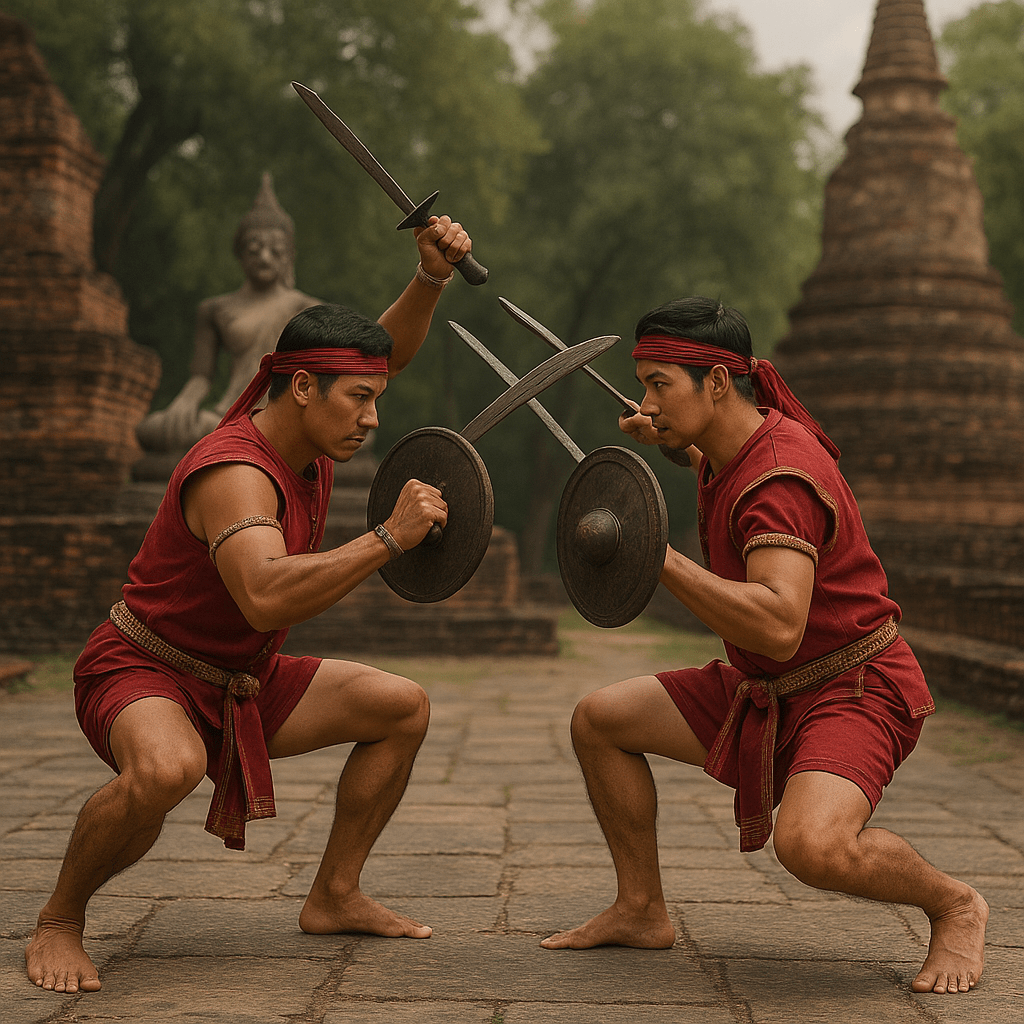
The curved sword, or krabi, is the signature weapon of Thailand’s ancient warrior tradition. Designed for both cutting and thrusting, its elegant curve is more than aesthetic — it allows for swift, fluid strikes that can change direction in mid-motion. Historically, the krabi was the weapon of choice for elite guards and battlefield generals, crafted with precision to balance speed, control, and lethal efficiency. Beyond its practical function, the krabi carried symbolic weight. It represented honor, courage, and the responsibility of the warrior to protect their community. The blade itself was often seen as an extension of the warrior’s spirit.
The krabong, a long staff often made of hardwood or bamboo, is the other half of the art’s namesake. While it may seem simpler than the ornate krabi, its versatility made it a weapon of the people. Farmers, guards, and soldiers alike could wield the krabong effectively, using its length for striking, sweeping, blocking, and even disarming opponents. In many ways, it symbolized adaptability — the ability to turn an everyday object into a tool for defense. The krabong also served as a training foundation for other polearms and spears, making it essential to a warrior’s education.
In traditional Siam, these weapons were more than tools of war; they were embedded in the cultural and spiritual life of the nation. Before battle or training, warriors often performed rituals to honor the weapons, seeking blessings for strength and clarity. The krabi and krabong were sometimes inscribed with sacred symbols or wrapped with charms believed to offer protection. This fusion of martial skill and spiritual belief reflects the Thai view that a true warrior must be as disciplined in spirit as in body.
Today, while few wield these weapons in actual combat, their symbolism remains alive in martial arts schools across the world. The krabi stands as a reminder of precision and honor, while the krabong embodies resilience and resourcefulness. Together, they represent the dual nature of the Krabi Krabong practitioner — sharp and refined, yet grounded and adaptable. To train with these ancient tools is to connect with a living history, carrying forward a tradition that honors both the art of war and the spirit of the warrior.
 Central FL Systema