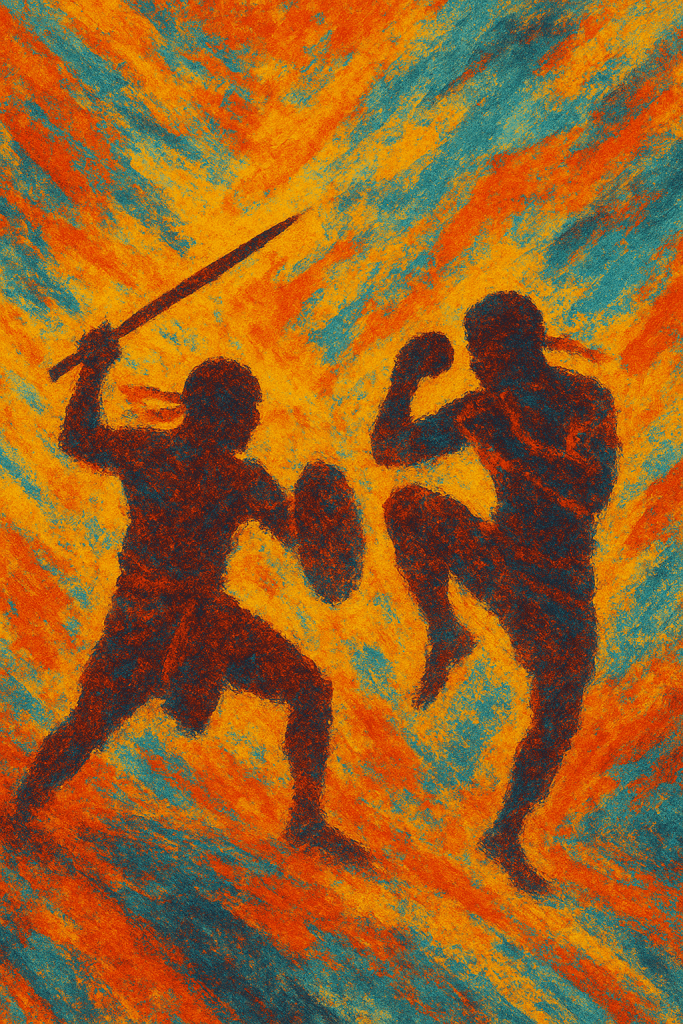
Krabi Krabong and Muay Boran share the same ancestral soil, both born out of the battlefield where survival demanded fluidity of hand, foot, and weapon. Krabi Krabong offered the warrior his sword, staff, and shield, while Muay Boran gave him the strength of his own body as a weapon. Together they formed a seamless whole, ensuring that when the sword was lost or broken, the body itself became the blade. This connection reveals not just a martial system, but a philosophy—never be without means to defend, attack, and prevail.
The movements of Muay Boran reflect the very strikes of Krabi Krabong. The downward arc of a sword finds its echo in the chopping elbow. The thrust of a spear lives in the long knee. Even the spinning motions of the staff reappear in the sweeping kicks. What was once a tool of steel and wood becomes flesh and bone, carrying the same angles, the same intention. To practice one without the other is to see only half of the picture, for each art explains the roots of the other.
This connection also explains why Muay Boran techniques are more expansive and dramatic compared to modern Muay Thai. They were battlefield movements, designed to disable quickly and completely, just as a sword or staff would. Every strike had to be decisive, every defense sharp, every motion purposeful. By mirroring the weapon in the body, Muay Boran preserved the warrior’s full arsenal even when stripped of arms.
Today, training in Krabi Krabong alongside Muay Boran revives this ancient completeness. The fighter learns not only to strike, but to embody the weapon. The art becomes more than a fight—it becomes a living tradition of transformation. Steel becomes sinew, wood becomes willpower, and the spirit of the warrior flows through both. The two are not separate, but two sides of the same shield, bound together by history and the enduring rhythm of survival.
 Central FL Systema